How Pharmacist-Led Minor Ailment Care Is Improving Access — Responsibly
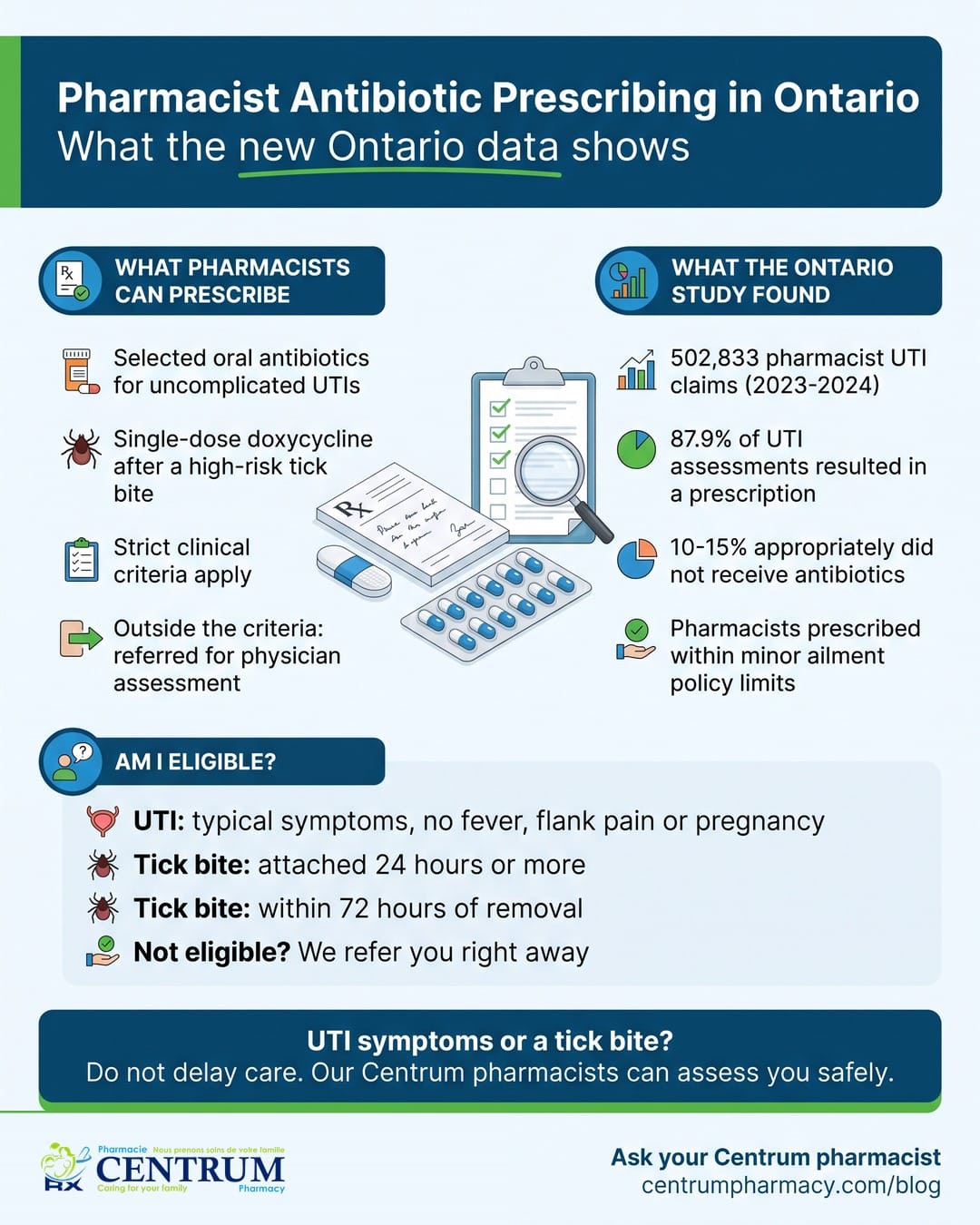
In January 2023, pharmacists in Ontario were granted the authority to prescribe medications for 13 minor ailments, including selected oral antibiotics for:
- Uncomplicated urinary tract infections (UTIs)
- Lyme disease prophylaxis following a high-risk tick bite
This policy shift represents a significant evolution in community-based primary care — and early research shows that pharmacists are prescribing responsibly and within defined clinical boundaries.
At Centrum Pharmacy, this expanded scope aligns directly with our integrated care model alongside Orleans Family Health Clinic and our commitment to the 4 C’s: Complete, Comprehensive, Caring, and Connected Care.
What Can Ontario Pharmacists Prescribe?
For acute uncomplicated cystitis (UTI) in eligible patients (non-pregnant females ≥12 years, no complicating features), pharmacists may prescribe:
- Nitrofurantoin
- Fosfomycin
- Sulfamethoxazole/trimethoprim
For Lyme disease prophylaxis, pharmacists may prescribe:
- A single dose of doxycycline following a high-risk tick bite in asymptomatic individuals
Strict clinical criteria apply. Patients who fall outside these parameters are referred for physician assessment — reinforcing patient safety and antimicrobial stewardship.
What Did the Ontario Study Show?
A retrospective Ontario study examined antibiotic prescribing before pharmacist authority (2022) and after implementation (2023–2024).
Key Findings
UTI Assessments
- 502,833 pharmacist claims for UTIs (2023–2024)
- 99% of UTI patients were female
- 65% were ages 25–64; 23% were ≥65
- 83% were in-person visits
- 87.9% resulted in a prescription
- 10–15% appropriately did not receive antibiotics
Tick Bite Assessments
- 37,798 pharmacist claims
- 50% ages 25–64; 30% ≥65
- 88% in-person visits
- 85.8% resulted in doxycycline
- Prescribing peaked in spring and fall
Antibiotic Prescribing Trends (Per 1,000 Inhabitants)
UTIs (Eligible Female Population)
- Pharmacist prescribing increased from 0.25 (2022) → 30.08 (2023) → 37.27 (2024)
- Physician prescribing decreased from 93.61 (2022) → 75.89 (2023) → 67.32 (2024)
- Net increase: 10.1 prescriptions per 1,000 inhabitants per year
This suggests pharmacists are absorbing a portion of minor ailment visits that would otherwise have gone to physicians — improving access while maintaining clinical standards.
Lyme Disease Prophylaxis
- Pharmacist doxycycline prescribing increased modestly
- Physician prescribing also rose, largely due to increasing tick exposure
What Does This Mean for Antimicrobial Stewardship?
Antimicrobial resistance remains a global threat. Appropriate antibiotic use is essential.
The study concluded:
- Pharmacists are prescribing within minor ailment policy limits
- Non-prescribing rates (10–15%) indicate clinical assessment — not automatic dispensing
- Continued education in antimicrobial stewardship remains essential
At Centrum Pharmacy, antimicrobial stewardship is embedded into our workflow. We:
- Conduct structured clinical assessments
- Apply evidence-based criteria
- Refer complex cases immediately
- Document thoroughly and communicate with primary care providers
- Integrate care with Orleans Family Health Clinic
This is not retail medicine. This is coordinated, accountable primary care.
Why Pharmacist-Led Minor Ailment Care Matters
Ontario continues to face significant primary care access challenges. Many patients do not have timely access to a family physician.
Centrum Pharmacy stands apart because:
- We actively recruit physicians
- We integrate pharmacy and medical care under one coordinated model
- We successfully roster patients with family doctors
- We provide minor ailment assessments as part of a larger care ecosystem
Our approach ensures patients receive:
- Complete care: addressing the full clinical picture
- Comprehensive care: evidence-based treatment and follow-up
- Caring care: accessible, compassionate support
- Connected care: seamless communication between pharmacist and physician
When Should You See a Pharmacist for a UTI or Tick Bite?
You may be eligible if:
- Typical symptoms (burning urination, frequency, urgency)
- No fever, flank pain, pregnancy, or complicating factors
Tick Bite
- Tick attached ≥24 hours
- Within 72 hours of removal
- Occurred in a high-risk area
- No current Lyme symptoms
If you are not eligible, we will refer you immediately to appropriate medical care.
The Bottom Line
The data show that pharmacist antibiotic prescribing in Ontario is:
- Structured
- Policy-compliant
- Improving access
- Modestly impacting total prescribing rates
- Aligned with antimicrobial stewardship principles
At Centrum Pharmacy, we are proud to be part of a modern, integrated primary care solution — expanding access responsibly while protecting the effectiveness of antibiotics for future generations.
If you have symptoms of a UTI or have experienced a tick bite, do not delay care. Our pharmacists are ready to assess you safely and appropriately.
Stay Connected with Centrum Pharmacy!
If you found this article helpful, don’t forget to like, share, and Follow to stay up to date on our latest health tips, pharmacy updates, and wellness advice.
Come for the Convenience, Stay for the Service.
Caring for Your Family Since 1999
Disclaimer: The medical information on this site is provided as an information resource only and is not to be used or relied on for any diagnostic or treatment purposes. This information does not substitute for professional diagnosis and treatment. Please do not initiate, modify, or discontinue any treatment, medication, or supplement solely based on this information. Always seek the advice of your healthcare provider first. Full Disclaimer.