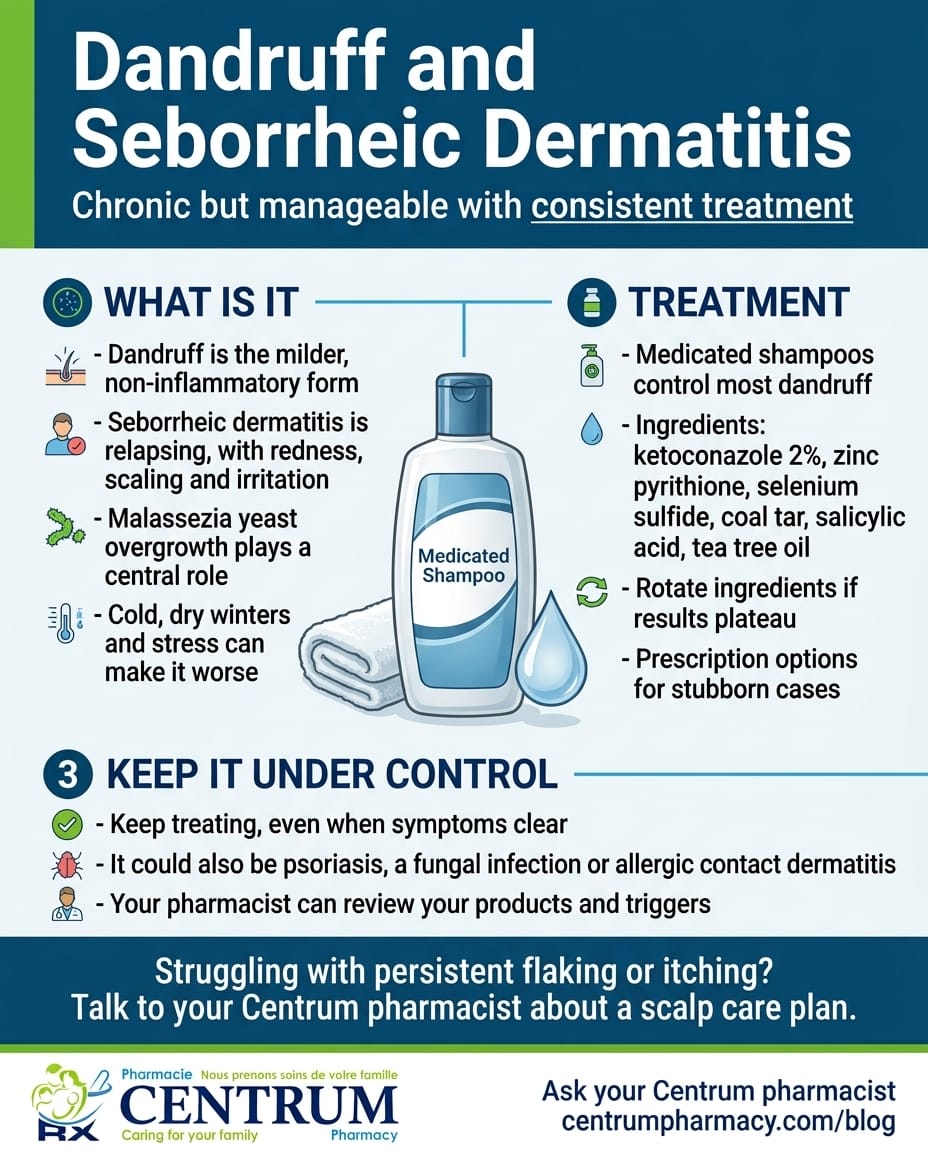
Dandruff and seborrheic dermatitis are among the most common chronic scalp conditions seen in community pharmacy practice. Both are associated with itching, flaking, and inflammation that can cause embarrassment, discomfort, and significant impact on quality of life. While dandruff represents the milder, non-inflammatory form of the disorder, seborrheic dermatitis is a more severe, relapsing condition marked by visible redness, scaling, and irritation of the scalp and other oil-producing areas of the body.
Causes and Contributing Factors
Recent Canadian expert reviews emphasize that both dandruff and seborrheic dermatitis share a complex, multifactorial origin. The Malassezia yeast (a normal inhabitant of the skin) plays a central role, but its overgrowth triggers inflammation and excessive shedding in susceptible individuals.
Other contributing factors include:
- Genetic predisposition: Up to 11 genetic mutations or protein deficiencies have been identified in relation to seborrheic dermatitis.
- Environmental influences: Cold, dry climates (like Canada’s winters) and stress can exacerbate symptoms.
- Immunologic conditions: Higher prevalence is seen in patients with HIV, hepatitis C, cancer, and chronic alcoholism.
- Ethnic variation: Patients with darker skin tones may experience petaloid seborrheic dermatitis, a more severe and extensive form of the condition.
Despite the high prevalence, there are no formalized Canadian clinical guidelines for diagnosis and treatment, making pharmacists’ frontline role in symptom recognition and patient education especially important.
Treatment Overview
The primary goal is to reduce Malassezia proliferation, restore scalp health, and minimize relapse frequency.
Over-the-Counter (OTC) Options
For most patients, dandruff can be effectively controlled with non-prescription medicated shampoos containing:
- Ketoconazole 2% – antifungal action
- Zinc pyrithione or selenium sulfide – antifungal and sebum-regulating
- Coal tar or salicylic acid – keratolytic and anti-inflammatory
- Tea tree oil – natural antifungal with mild anti-itch properties
Tip from our Centrum pharmacists: Rotate between different active ingredients if results plateau. Each formulation acts differently on the scalp’s microbiome.
Prescription and Advanced Therapies
For moderate-to-severe seborrheic dermatitis, the review suggests:
- Clobetasol 0.05% shampoo (twice weekly) alternating with ketoconazole shampoo for flare control.
- Topical corticosteroids (short-term only) for inflamed areas.
- Topical antifungals (ketoconazole, miconazole, ciclopirox olamine) for long-term control and to reduce bacterial overgrowth.
- Roflumilast 0.3% foam, recently approved by Health Canada, as a nonsteroidal alternative for patients seeking to avoid steroid use.
Systemic Therapies for Resistant Cases
When topical treatments fail:
- Oral antifungals (e.g., itraconazole, fluconazole) may be used under medical supervision.
- Oral retinoids (e.g., isotretinoin) in low doses can help reduce sebum production.
- Hormonal therapy may be considered for patients with sebum-driven flaking or oiliness.
Pharmacist’s Perspective
At Centrum Pharmacy, our clinical pharmacists regularly help patients distinguish between dandruff and more serious scalp conditions such as psoriasis, fungal infections, or allergic contact dermatitis. We guide patients through safe product selection, proper shampoo use, and long-term maintenance routines.
We also stress the importance of patient education, explaining that these conditions are chronic but manageable, and that consistent treatment, even during remission, prevents recurrence.
What’s Next: The Need for Canadian Guidelines
The experts behind the review call for the development of formal, evidence-based Canadian guidelines to answer key clinical questions:
- What are the ideal first- and second-line treatments?
- How long should each therapy be continued?
- Which products are safest for sensitive populations?
- How can relapses be prevented?
Given Canada’s diverse population, future management strategies must reflect ethnic skin variations, environmental factors, and access to care. Until standardized guidelines are available, pharmacists remain the most accessible and trusted resource for individualized care and education.
Visit Centrum Pharmacy for Personalized Scalp Care
If you’re struggling with persistent dandruff or seborrheic dermatitis, Centrum Pharmacy can help you choose the most effective treatment plan tailored to your scalp type, medical history, and preferences.
Our pharmacists will review your current products, identify triggers, and guide you toward a complete, comprehensive, caring, and connected (4C) approach to scalp health.
Located inside Orleans Family Health Clinic.
Ask our pharmacists today about effective dandruff and seborrheic dermatitis management.
Stay Connected with Centrum Pharmacy!
If you found this article helpful, don’t forget to like, share, and Follow to stay up to date on our latest health tips, pharmacy updates, and wellness advice.
Come for the Convenience, Stay for the Service.
Caring for Your Family Since 1999
Disclaimer: The medical information on this site is provided as an information resource only and is not to be used or relied on for any diagnostic or treatment purposes. This information does not substitute for professional diagnosis and treatment. Please do not initiate, modify, or discontinue any treatment, medication, or supplement solely based on this information. Always seek the advice of your healthcare provider first. Full Disclaimer.